
Social Security lets you start retirement benefits any time from age 62 to 70. Start early and each monthly check is permanently smaller; wait and it is permanently larger. For anyone born in 1960 or later (full retirement age 67), claiming at 62 pays 70% of your full benefit, 67 pays 100%, and 70 pays 124% — so the age-70 check runs 1.77× the age-62 check. The tradeoff is symmetric: a smaller check for more years, or a bigger check for fewer. The age where the bigger-later benefit's running total catches up to the smaller-earlier one is the breakeven — and it is the same arithmetic whatever you decide to do with it.
This page is a calculator's worth of fact, not advice. Below are the benefit factors, the simple breakeven ages, and — just as important — the two conditions that decide which side of the breakeven you are betting on.
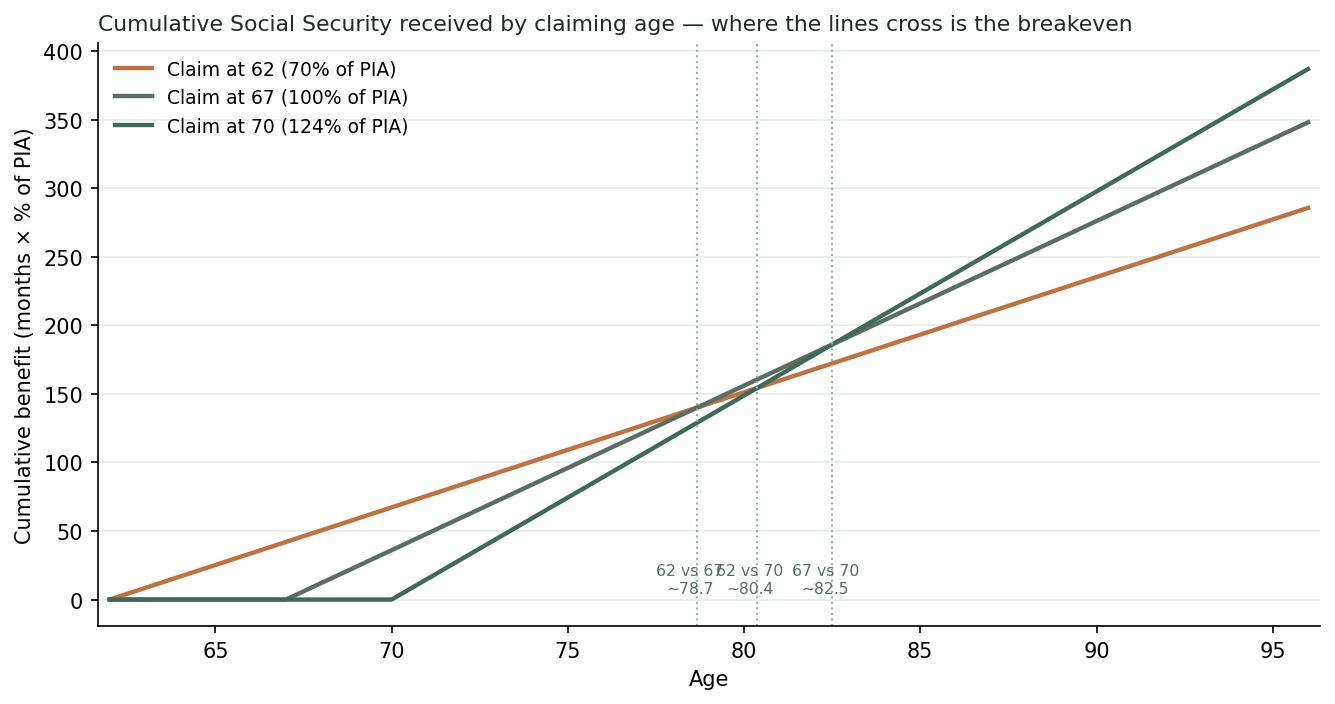

The factors, and the breakevens
| Claim age | % of full benefit (PIA) | Monthly per $1,000 of PIA |
|---|---|---|
| 62 (earliest) | 70% | $700 |
| 67 (full retirement age) | 100% | $1,000 |
| 70 (latest credit) | 124% | $1,240 |
| Comparison | Simple (undiscounted) breakeven age |
|---|---|
| Claim 62 vs 67 | ~78 years 8 months (78.7) |
| Claim 62 vs 70 | ~80 years 4 months (80.4) |
| Claim 67 vs 70 | ~82 years 6 months (82.5) |
Read it symmetrically. Take the 62-vs-70 line: before about age 80, the person who claimed at 62 has collected more in total; after about 80, the person who waited to 70 pulls ahead — and stays ahead, by a widening margin, for as long as they live. Neither is "right"; the breakeven just tells you the age at which the bet flips.
The two conditions behind "waiting wins past 80"
That ~80 figure is real but conditional, and both conditions are easy to drop by accident:
1. You have to outlive it. "Waiting wins" only pays for the years you are alive past the breakeven. Whether reaching ~80 is likely is a separate question — the SSA period life table is the place to answer it for your age and sex — and it is the reason longevity expectations, not just the breakeven number, drive the decision.
2. These breakevens are undiscounted. They count a dollar at 82 as equal to a dollar at 64. If a dollar today is worth more to you than a dollar in twenty years — that is, at any positive discount rate — the breakeven moves later, and you have to live even longer for waiting to come out ahead. Every "just wait until 70" rule of thumb quietly assumes a zero discount rate; this page does not.
Cost-of-living adjustments (COLAs) do not change the breakeven age. The annual COLA raises the benefit at every claiming age by the same percentage, so the ratios between them are preserved and the simple breakeven is unaffected — which is exactly why it can be stated without an inflation assumption.
How we built this
The benefit factors are statutory, for workers born in 1960 or later (full retirement age 67): a 30% reduction at 62 (→70% of PIA), 100% at full retirement age, and delayed-retirement credits of 8% per year to age 70 (→124%). The simple breakeven is pure arithmetic on those factors — cumulative payments at the earlier claim age versus the later one, set equal, solved for age. No survival probabilities, discount rate, taxes, earnings test, or spousal/survivor benefits enter the breakeven age itself; those are real-world modifiers a reader applies on top, and the two conditions above flag the two that move the answer most.
Sources
SSA, Office of the Chief Actuary — Early or Late Retirement (statutory reduction and delayed-retirement-credit factors); SSA Period Life Table (for the longevity condition). Canopy Press analysis; simple undiscounted breakevens computed from the statutory factors.