
Headlines about the “average retirement balance” describe almost no one. In the Federal Reserve’s 2022 Survey of Consumer Finances, the median U.S. household held $4,000 in retirement accounts — counting every household. Among the 54.3% of households that actually have a retirement account, the median was $87,000; the mean for that same group was $334,097 — about 3.8× the median.
The gap between “the average” and what a typical household holds is real, but it is not one thing. It decomposes into two independent distortions, and honest reporting keeps them separate.
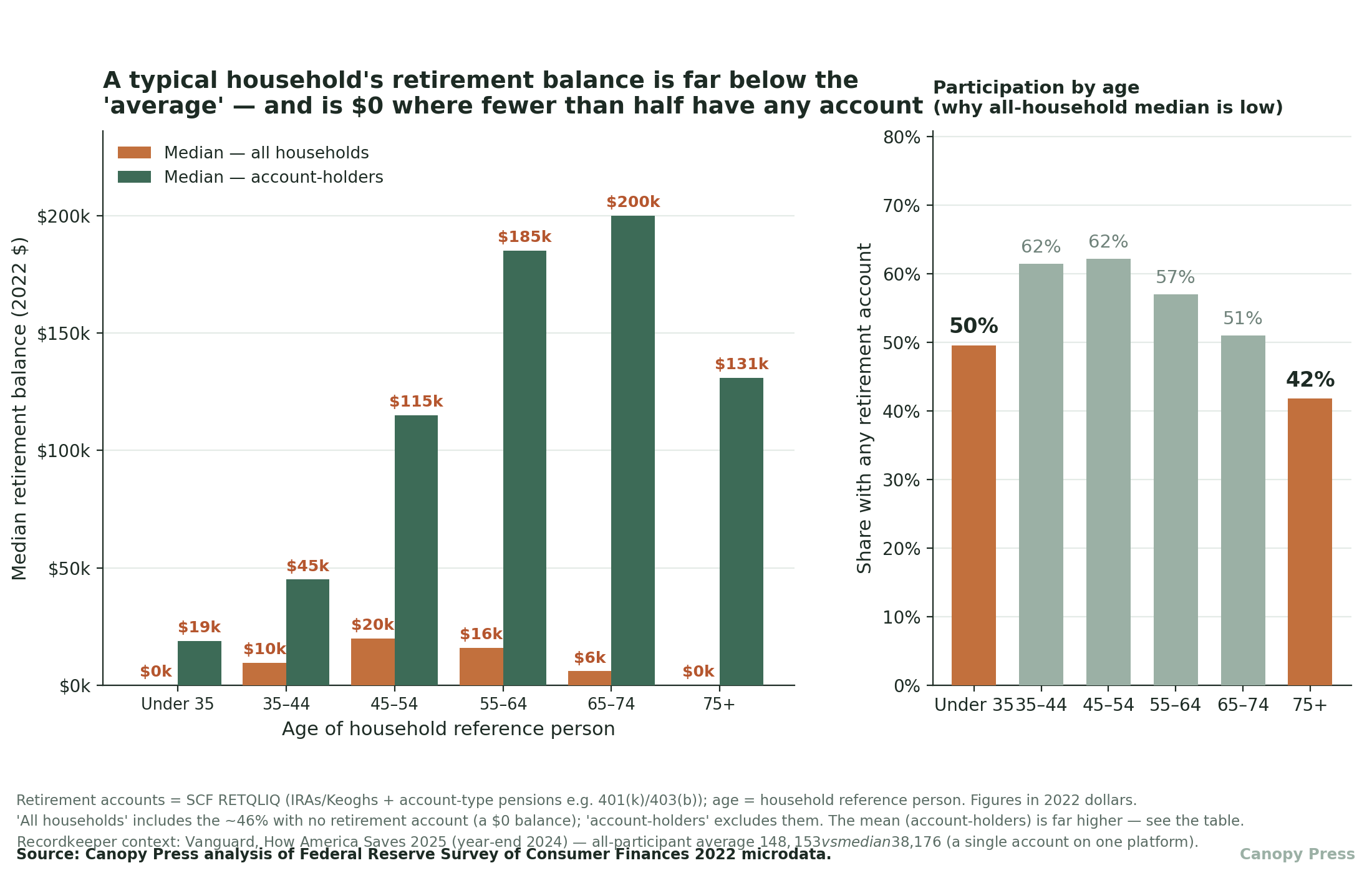

By age of household
| Age of household | Has any retirement account | Median — all households | Median — account-holders | Mean — account-holders |
|---|---|---|---|---|
| Under 35 | 49.6% | $0 | $18,880 | $49,127 |
| 35–44 | 61.5% | $9,600 | $45,000 | $141,517 |
| 45–54 | 62.2% | $20,000 | $115,000 | $313,220 |
| 55–64 | 57.0% | $16,000 | $185,000 | $537,563 |
| 65–74 | 51.0% | $6,000 | $200,000 | $609,229 |
| 75+ | 41.8% | $0 | $131,000 | $464,692 |
“Median — all households” counts every household in the age group, including those with no retirement account; where fewer than half have an account (under-35 and 75+), that median is $0. “Median — account-holders” and “Mean — account-holders” count only households that hold a retirement account.
What the “average” hides
Distortion 1 — mean vs median. Among account-holders, the 2022 mean balance ($334,097) is 3.8× the median ($87,000) — a handful of very large accounts pull the average up. Recordkeeper data shows the same shape: Vanguard’s 2024 all-participant average was $148,153 against a median of $38,176 (How America Saves 2025). Vanguard’s average is less than half the SCF account-holder mean ($334,097) because the two count different things: the SCF figure is a household’s entire retirement portfolio across every institution (all of its IRAs and 401(k)s, including accounts left at former employers), while Vanguard reports a single account on a single recordkeeping platform — a household-total versus a single-account figure, not merely a different sample.
Distortion 2 — who is counted. Recordkeeper and account-holder averages describe people who already have an account. But only 54.3% of U.S. households have a retirement account at all. Count everyone, and the median household holds $4,000. The two distortions compound: the move from a $148,153-style “average” down to the $4,000 all-household median is part skew, part coverage — not either alone.
Methodology
The spine. Figures are Canopy Press’s recompute of the Federal Reserve Survey of Consumer Finances 2022 Summary Extract Public Data (variable RETQLIQ: IRAs/Keoghs plus account-type pensions such as 401(k)/403(b)), by age of the household reference person (AGECL). All five imputation implicates are pooled and weighted by the survey weight WGT; the weighted median is the first value reaching half the total weight. Dollars are nominal 2022. The participation rate is the share of households with RETQLIQ > 0.
Populations, kept distinct. The unconditional median (and the participation rate) cover all households; the conditional median and the mean cover account-holders only. We label every figure with its population and never average across the two.
Recordkeeper context (cited, not recomputed). Vanguard’s How America Saves 2025 (year-end 2024) reports balances for participants who hold an account on the Vanguard defined-contribution platform — a single account on one platform, not a household’s total across institutions, and a different population and later year than the SCF spine. That single-account basis is why its average sits well below the SCF account-holder mean. We cite it as parallel, same-direction evidence of the mean-vs-median skew, not as a like-for-like comparison.
Confidence. High for the within-SCF facts (skew, participation, the all-household vs account-holder gap), which come straight from the SCF 2022 microdata. The cross-source comparison with Vanguard is directional — different populations and years.
Transformed figures are Canopy Press’s analysis of the underlying federal microdata, not “Federal Reserve data.” Reuse permitted with attribution to Canopy Press (CC BY 4.0). Full underlying figures: CSV download. Sources: Federal Reserve, Survey of Consumer Finances 2022; Vanguard, How America Saves 2025.
Further reading from Canopy Press
Cite or reuse this data (CC BY 4.0 with attribution):
Canopy Press (2026). “What a typical household actually has saved for retirement — and why the “average” is so misleading.” https://canopy.press/research/retirement-account-balances-by-age-2022/
Journalists: data questions answered at [email protected]. New research lands first in The Canopy Brief (weekly, free).