
401(k) vs Roth IRA: The Exact Order to Fund Your Accounts
Most people contribute to their 401(k) on autopilot and skip the Roth IRA entirely — a sequencing mistake that could cost tens of thousands in retirement tax savings.
- The $146K Average 401(k) Balance Hides a Critical Retirement Planning Mistake
- 401(k) in 2026: Contribution Limits, Employer Matches, and the New "Super Catch-Up"
- Roth IRA in 2026: Tax-Free Growth, No RMDs, and Income Phase-Outs You Need to Know
- 401(k) vs Roth IRA: Tax Brackets, RMDs, and the SECURE 2.0 Changes That Shift the Math
- The 25-Year Dollar Difference: Five Strategies Side by Side
- The Three-Step Playbook: Exactly What to Do With Your Next Dollar
The $146K Average 401(k) Balance Hides a Critical Retirement Planning Mistake
The average 401(k) balance hit a record $146,400 in the fourth quarter of 2025, according to Fidelity's Q4 2025 retirement trends report. Sounds encouraging — until you see the median: just $38,176, per Vanguard's How America Saves 2025 report (covering 2024 plan data). Half of all 401(k) participants have less than $38,000 saved.
That gap isn't just about income. It's about strategy versus autopilot.
Most people sign up for their employer's 401(k), pick a contribution rate that feels responsible — usually 6% to 8% — and never touch it again. They skip the Roth individual retirement account (IRA). They never check whether their plan's expense ratios are quietly eating their returns. They certainly don't run the numbers on whether pre-tax or after-tax dollars will serve them better thirty years from now.
The strategic approach isn't complicated, but it demands an active choice about which account gets your dollars first. That choice hinges on something most people ignore: the difference between a tax deduction today and tax-free income in retirement.
Key Takeaways
- Capture the full employer match before doing anything else. The average match adds $3,525/year on a $75,000 salary — an 80% blended return on common match formulas that no market investment can consistently beat.
- The optimal sequence is 401(k) to match → Roth IRA to $7,500 → back to 401(k). This three-step order captures free money first, then tax-free growth, then the remaining tax-deferred space.
- Tax rates are the deciding variable, not account labels. If you expect to drop two brackets in retirement, traditional wins.
- SECURE 2.0 changed the rules for high earners. Starting in 2026, catch-up contributions must go into a Roth 401(k) if your prior-year wages exceeded $145,000 — check with HR now.
About 86% of companies offering a 401(k) provide matching contributions, according to the Plan Sponsor Council of America. Almost everyone reading this has access to free money they may not be fully capturing. If you're not contributing enough to get the full match, the 401(k)-versus-Roth question is premature — you're leaving guaranteed returns on the table.
Only 14% of 401(k) participants max out their annual contributions, per Fidelity. The remaining 86% have unused tax-advantaged space — and many aren't even capturing their full employer match.
401(k) in 2026: Contribution Limits, Employer Matches, and the New "Super Catch-Up"

The IRS raised the 401(k) employee contribution limit to $24,500 for 2026, up from $23,500 in 2025, per IRS Notice 2025-82. The total combined limit — your contributions plus your employer's — climbed to $72,000. (Canopy Press tracks every 401(k) and IRA limit from 2016 through 2026 — each year verified against the annual IRS notice.)
Those numbers sound abstract. Here's what they mean for a real paycheck. Say you earn $75,000 and your employer matches dollar-for-dollar on your first 3% of salary plus 50 cents on the dollar for the next 2%. That's the most common formula, per Fidelity. To capture the full match, you need to contribute at least 5% — $3,750 out of your paycheck.
The math breaks down simply. You put in 3% of your salary — $2,250 — and your employer matches every dollar. Then you put in another 2% — $1,500 — and they match fifty cents on each dollar. Your total match: $3,000 of free money on a $3,750 contribution. That's an 80% return before the money even touches the stock market.
The average employer match across all plans runs 4.7% of salary. On a $75,000 income, that's $3,525 per year in free contributions. Over 25 years at 7% annualized real returns, that match alone grows to roughly $227,000. Ignoring it is the most expensive financial mistake you can quietly make.
The catch-up changes matter if you're over 50. The standard 401(k) catch-up contribution for workers 50 and older is $8,000 in 2026, pushing the total employee limit to $32,500. But the Setting Every Community Up for Retirement Enhancement 2.0 Act (SECURE 2.0) introduced a "super catch-up" for workers aged 60 through 63: you can contribute an additional $12,000 instead of $8,000, for a total employee limit of $36,500 per IRS guidelines.
If you're 61 years old earning $150,000, that super catch-up lets you shelter $35,750 from income taxes in a single year. At the 24% marginal rate, that's $8,580 in tax savings — real dollars staying in your pocket instead of going to the IRS.
One critical SECURE 2.0 change for high earners: starting in 2026, if your Federal Insurance Contributions Act (FICA) wages exceeded $145,000 in the prior year, your catch-up contributions must go into a Roth (after-tax) 401(k) account. You can still make them — you just won't get the upfront tax deduction. If your plan doesn't offer a Roth 401(k) option, it must add one or eliminate catch-up eligibility for high earners entirely. Check with your HR department now if you're near that threshold.
Not every 401(k) deserves your full contribution, though. Plans with limited fund choices and high expense ratios (some charge 0.5% to 1.0% or more) impose a stealth tax on your retirement. The average 401(k) equity fund charges 0.26% per the Investment Company Institute, but averages hide bad plans. Compare that to Vanguard's average of 0.06% across all funds. If your plan is expensive, contribute enough to get the match, then redirect additional savings to a Roth IRA where you control the investments.
Recommended reading: Limited
Roth IRA in 2026: Tax-Free Growth, No RMDs, and Income Phase-Outs You Need to Know
The Roth IRA contribution limit for 2026 is $7,500, up from $7,000 in 2025, per IRS guidelines. Workers 50 and older can add a $1,000 catch-up, bringing their total to $8,500.
Those limits look tiny next to the 401(k)'s $24,500. So why does the Roth IRA deserve your dollars second — ahead of maxing the 401(k)?
Three things the 401(k) can't offer. And their value compounds the longer you hold the account.
Start with tax-free withdrawals. Every dollar of gains in a Roth IRA comes out tax-free in retirement, provided the account has been open at least five years and you're 59½ or older. Put in $7,500 a year from age 30 to 60 at 7% real returns, and you'd have about $708,000. Every dollar is yours — zero taxes on withdrawal. Run the same scenario in a traditional 401(k). Same contributions, same returns, but you owe 22% on every withdrawal. Your after-tax total: $552,000. That's $156,000 less from the exact same money.
Then there's the RMD advantage. Traditional 401(k) accounts force you to start taking withdrawals at age 73 (or 75 if born in 1960 or later) under SECURE 2.0. Those forced withdrawals count as taxable income, and they can push you into higher brackets, increase your Medicare premiums through Income-Related Monthly Adjustment Amounts (IRMAA), and make more of your Social Security benefits taxable. Roth IRAs have no required minimum distributions (RMDs) — ever. You can let the money grow untouched and pass it to heirs who receive it tax-free (though they must draw it down within 10 years under current rules).
The third edge is contribution access. You can withdraw your Roth IRA contributions — not earnings, just what you put in — at any time, for any reason, with no taxes and no penalties. That makes the Roth double as a last-resort emergency fund. You shouldn't plan on raiding it — but knowing you can pull contributions penalty-free gives it a safety-valve quality the 401(k) can't match.
Income limits are the catch. For 2026, the Roth IRA begins phasing out at $153,000 in modified adjusted gross income (MAGI) for single filers and disappears entirely at $168,000. For married couples filing jointly, the range is $242,000 to $252,000, per IRS guidelines. If you earn above these thresholds, you can't contribute directly — but the backdoor Roth conversion remains available. You contribute to a traditional IRA (no income limit for non-deductible contributions) and immediately convert to a Roth. It's legal, the IRS has acknowledged it in Notice 2014-54, and it takes about 15 minutes to set up with most brokerages. Note: if you hold other pre-tax IRA funds, the pro-rata rule may trigger a partial tax on the conversion.
When does the Roth IRA lose to the 401(k)? If you're in peak earning years, expect to drop two or more tax brackets in retirement, and aren't worried about future rate increases, the traditional 401(k) deduction is more valuable dollar-for-dollar. A 55-year-old single filer earning $200,000 (24% bracket) who expects $60,000 in retirement income (12% bracket) saves more by deferring taxes now. But that bet rests on two assumptions: that your income will drop significantly, and that Congress won't raise rates. If either assumption breaks, the Roth wins.
401(k) vs Roth IRA: Tax Brackets, RMDs, and the SECURE 2.0 Changes That Shift the Math
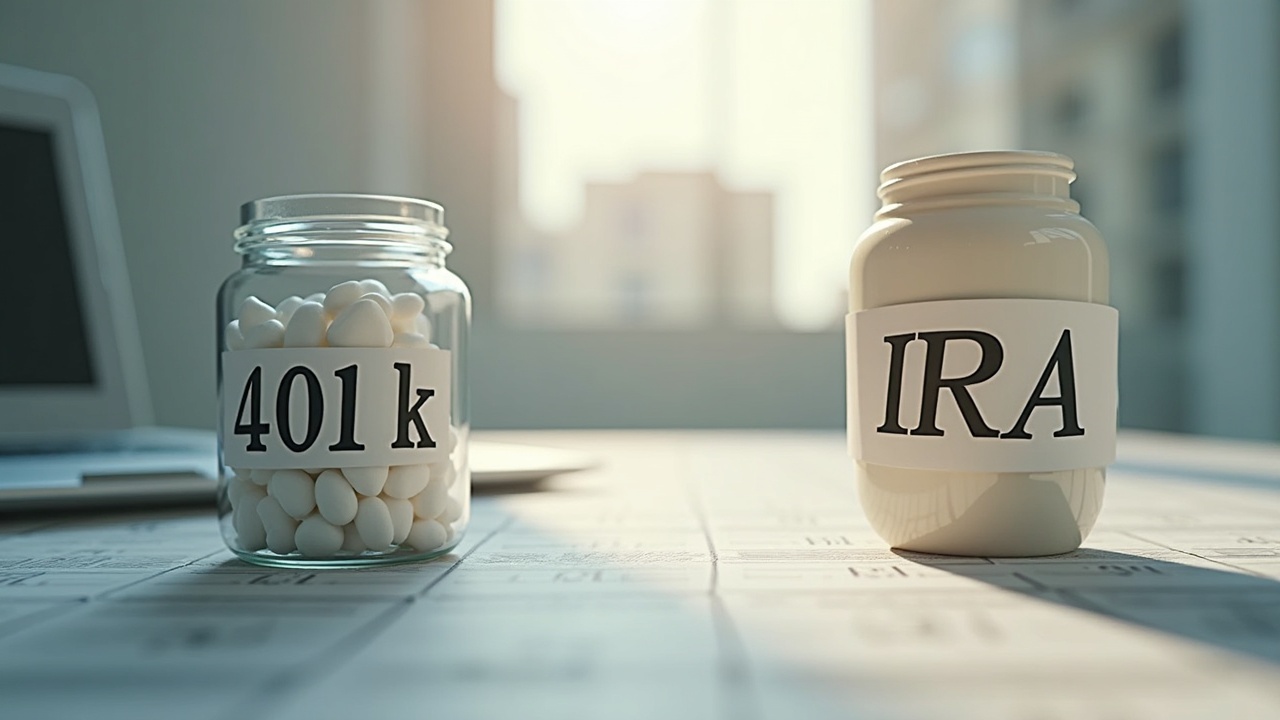
The conventional wisdom — "defer taxes now, pay later" — only works if your tax rate actually drops in retirement. For a growing number of workers, that assumption is shaky.
The tax bracket question is the whole game. If you're in the 22% bracket today (roughly $48,500 to $103,350 in taxable income for single filers) and expect to stay near that bracket in retirement, the math between pre-tax 401(k) and Roth contributions is essentially a wash. Pay 22% now or 22% later. But two forces tilt the scales toward Roth for most people in the 12% and 22% brackets.
First, tax rates are historically low. The Tax Cuts and Jobs Act (TCJA) rates — the 10% through 37% brackets you're paying now — were preserved through the One Big Beautiful Bill Act. No guarantee they stay this low permanently. Federal debt stands above $36 trillion. If rates revert to pre-2017 levels, today's 22% bracket becomes 25%, and the 12% bracket becomes 15%. Locking in current rates through Roth contributions is insurance against that scenario.
Second, RMDs create forced taxable income. Even if you plan to live modestly in retirement, a $1.5 million traditional 401(k) balance will generate RMDs of roughly $55,000 to $60,000 per year starting at age 73. Add Social Security benefits, and you could land in the 22% bracket whether you planned to or not. Roth accounts sidestep this entirely.
Get the free 2026 Budget Tracker Template
A plug-and-play monthly budget plus the 5-step system that makes it stick. Delivered instantly.
Free download. We email The Canopy Brief weekly. Unsubscribe anytime.
Consider a 35-year-old software developer earning $120,000 (22% marginal bracket, single filer). She contributes the full $24,500 to her traditional 401(k). Sounds disciplined — but the math tells a different story.
By age 45, she expects to earn $180,000 (24% bracket). By retirement at 65, her traditional 401(k) and Social Security together will generate roughly $90,000 to $110,000 in taxable income — landing her right back in the 22% bracket. She deferred at 22%, she'll pay at 22%, and she missed 30 years of tax-free compounding in a Roth.
Had she instead followed the three-step sequence — 401(k) to match ($6,000 in her case), Roth IRA to $7,500, then 401(k) for the remaining $11,000 — she'd build a tax-diversified portfolio. In retirement, she could pull from traditional accounts up to the top of the 12% bracket, then fill the rest of her spending from tax-free Roth funds. That bracket management strategy is worth tens of thousands over a 25-year retirement.
The average employer match of 4.7% adds $3,525 per year on a $75,000 salary — free money that grows to roughly $227,000 over 25 years at 7% returns. Only 14% of 401(k) participants max out their contributions (Fidelity).
The Roth 401(k) is the third path worth knowing about. If your employer offers one — and most large plans now do, partly because SECURE 2.0 requires it for high-earner catch-ups — you can contribute up to $24,500 on an after-tax basis. You get Roth tax treatment (tax-free withdrawals in retirement) with the 401(k)'s higher contribution ceiling. The trade-off: no upfront tax deduction, so your take-home pay drops more per dollar contributed.
For someone in the 22% bracket, contributing $24,500 to a Roth 401(k) costs $5,390 more in current-year taxes than the same contribution to a traditional 401(k). Over 25 years, is that worth it? If your retirement tax rate equals or exceeds 22%, yes — you've locked in 25 years of completely tax-free growth on $24,500 per year instead of just $7,500 in a Roth IRA.
There's also the mega backdoor Roth for high earners. If your plan allows after-tax contributions beyond the $24,500 employee limit (and permits in-plan Roth conversions or in-service distributions), you can funnel up to the $72,000 combined limit through the Roth door. Not every plan allows this, but if yours does, it's the single most powerful retirement savings move available. Ask your plan administrator specifically: "Does the plan allow after-tax contributions and in-plan Roth conversions?"
The 25-Year Dollar Difference: Five Strategies Side by Side
Numbers tell the story better than theory. Here's what happens when a 35-year-old earning $120,000 (22% marginal bracket, single) follows five different strategies for 25 years, assuming 7% real returns, consistent contributions, and stable tax brackets. The "after-tax retirement value" accounts for taxes owed on traditional withdrawals at 22%.
| Strategy | Annual contribution | After-tax value at age 60 |
|---|---|---|
| Traditional 401(k) only ($24,500 pre-tax) | $24,500 | ~$1,232,000 |
| Match first → Roth IRA → back to 401(k) | $24,500 total | ~$1,308,000 |
| Roth 401(k) only ($24,500 after-tax) | $24,500 | ~$1,580,000 |
| 60/40 split (trad 401k / Roth IRA) | $24,500 total | ~$1,271,000 |
| Mega backdoor Roth ($48,500 total) | $48,500 | ~$2,340,000 |
*Roth values assume no tax on withdrawal, which is their entire advantage. The Roth 401(k) "costs" more in take-home pay today since you're contributing after-tax dollars — $24,500 in a Roth 401(k) requires earning ~$31,400 pre-tax at the 22% bracket, versus $24,500 in a traditional 401(k) which only "costs" ~$19,110 after the tax deduction.
The match-first-then-Roth strategy beats traditional-only by roughly $76,000 over 25 years on identical total contributions. That's the value of tax diversification — having both pre-tax and tax-free buckets to draw from in retirement.
State taxes matter more than most people realize. If you live in Texas, Florida, Nevada, or another state with no income tax, the traditional 401(k) deduction only saves you federal taxes. Retire in the same no-tax state, and withdrawals are only taxed federally too — so the math between traditional and Roth depends purely on your federal bracket trajectory.
Move the same scenario to California (13.3% top state rate) or New York (10.9%), and the traditional 401(k) deduction suddenly saves you both federal and state taxes — a combined 35%+ marginal rate. If you plan to retire somewhere cheaper (and many Californians do), the traditional 401(k) wins by a wider margin because you're deferring at a high combined rate and withdrawing at a lower one. Staying put in a high-tax state? The Roth becomes more attractive — lock in today's rates before your state raises them further.
The Three-Step Playbook: Exactly What to Do With Your Next Dollar
Stop debating and start executing. Here's the exact priority order for your retirement dollars in 2026.
Step 1: 401(k) to the employer match. Log into your plan. Find your employer's match formula (HR can tell you). Set your contribution to whatever percentage captures the full match — usually 5% to 6%. On a $75,000 salary at 5%, that's $3,750 from you and up to $3,000 from your employer (on a typical dollar-for-dollar/50-cent formula). Do this before anything else.
Step 2: Max the Roth IRA at $7,500. Open a Roth IRA at Fidelity, Schwab, or Vanguard if you don't have one. Set up automatic monthly transfers of $625. Invest in a target-date fund or a simple three-fund portfolio (total U.S. stock, international stock, bonds). If your MAGI exceeds the phase-out limits, execute the backdoor Roth: contribute $7,500 to a traditional IRA, then convert to Roth immediately. Document the conversion for your tax preparer.
Step 3: Return to the 401(k) and push toward $24,500. Increase your 401(k) contribution rate until you're on pace to hit $24,500 for the year. On a $120,000 salary, that's about 20.4%. If your budget can't absorb the full amount, get as close as you can — even $20,000 per year (about 17%) puts you well ahead of the average contribution rate of 9.5% that Fidelity reports.
Bonus step for high earners: If your plan supports it, explore the mega backdoor Roth. After maxing your employee contributions, make after-tax contributions up to the $72,000 combined limit and convert them to Roth. This is the most powerful tax-advantaged savings vehicle available, hiding in plain sight in many 401(k) plans.
If you're 60 to 63, hit the super catch-up hard. The $11,250 additional contribution is a limited-time window — it closes after age 63 — and the tax-sheltered growth is significant even over a short horizon. Five years of $11,250 extra at 7% returns adds roughly $64,500 in additional retirement savings.
We covered the 401(k) catch-up changes in detail in our piece on 401(k) catch-up limit changes — worth reading if you're over 50 and navigating the new SECURE 2.0 rules. And if you're weighing the traditional versus Roth IRA question more broadly, our Traditional IRA vs Roth IRA comparison goes deeper on the tax-free growth math.
Explore by topic
Frequently Asked Questions
Should I contribute to a Roth IRA or 401(k) first?
Neither exclusively. The optimal order is 401(k) up to the employer match (free money you can't get elsewhere), then Roth IRA to $7,500 (tax-free growth with maximum flexibility), then back to the 401(k) for the remaining room. This three-step sequence captures the best features of both accounts.
Can I contribute to both a 401(k) and a Roth IRA in 2026?
Yes. The limits are independent — you can contribute $24,500 to your 401(k) and $7,500 to a Roth IRA in the same year, for a combined $32,000 in tax-advantaged savings. The only restriction is the Roth IRA income phase-out: single filers above $168,000 MAGI and joint filers above $252,000 MAGI can't contribute directly, but can use the backdoor Roth conversion.
What if my employer doesn't offer a 401(k) match?
Skip Step 1 and go straight to the Roth IRA. Without a match, the 401(k)'s only advantage is a higher contribution ceiling and an upfront tax deduction. Max the Roth IRA first for tax-free growth, then contribute to the 401(k) if you're in the 22% bracket or above and want the deduction. If you're in the 12% bracket, the tax deduction is worth less — lean heavier on Roth.
Is a Roth 401(k) better than a traditional 401(k)?
If you expect your tax rate in retirement to equal or exceed today's, the Roth 401(k) wins — you pay taxes at today's rate and withdraw tax-free later. The downside is reduced take-home pay: $24,500 in Roth 401(k) contributions costs about $5,390 more per year (at the 22% bracket) than the same amount in a traditional 401(k). If you can absorb that cost, the Roth 401(k) is the stronger long-term play for most workers in the 12% and 22% brackets.
Check Your Gap
Use our free Retirement Savings Calculator to see if you're on track — and how much more per month closes the gap.
The Canopy Brief
One financial insight. One career move. One tool worth knowing. Every Monday. 5 minutes. No fluff.
Free. No spam. Unsubscribe anytime.
Canopy Picks
Products we've vetted and recommend. We may earn a commission at no extra cost to you.
-
The Psychology of Money
Morgan Housel's timeless guide to how people actually think about money. -
The Simple Path to Wealth
JL Collins' road map to financial independence through index investing. -
You Need a Budget
The system behind YNAB — give every dollar a job. -
Credit Karma
Free credit score monitoring and personalized recommendations. -
Kapitalwise
Get matched with a vetted financial advisor in minutes.
Found an error? At Canopy Press, accuracy comes first. If you spot a claim that needs checking, let us know at [email protected] — we'll verify and correct it immediately.
Sources
- FRED - 10-Year Treasury Yield
- FRED - 30-Year Fixed Mortgage Rate
- FRED - Federal Funds Effective Rate
- FRED - Consumer Price Index (CPI)
- FRED - Unemployment Rate
- Yahoo Finance - S&P 500
- Yahoo Finance - 10-Year Treasury Yield (Market)
- Yahoo Finance - CBOE Volatility Index (VIX)
- Yahoo Finance - US Dollar Index
- Yahoo Finance - Gold Price (per oz)