
For 2026 the employee elective-deferral limit for 401(k) and 403(b) plans is $24,500 — up $1,000 from 2025 (IRS Notice 2025-67). Workers 50 and older can defer up to $32,500 — the base limit plus the $8,000 age-50 catch-up; workers who turn 60–63 during the year add the SECURE 2.0 'super catch-up' of $11,250 instead, and can defer up to $35,750 if their plan offers it. The IRA limit is $7,500 ($8,600 with the $1,100 age-50+ catch-up), and the all-source 415(c) cap — employee plus employer money combined — is $72,000.
Below the 2026 lookup sits the part no single IRS table publishes: the limit's history. Canopy Press assembled the elective-deferral and IRA limits for every year from 2016 through 2026 from the eleven annual IRS cost-of-living-adjustment notices — each year verified against the primary notice PDF — and joined the series against the Consumer Price Index for All Urban Consumers (CPI-U) to show how the caps have tracked inflation.
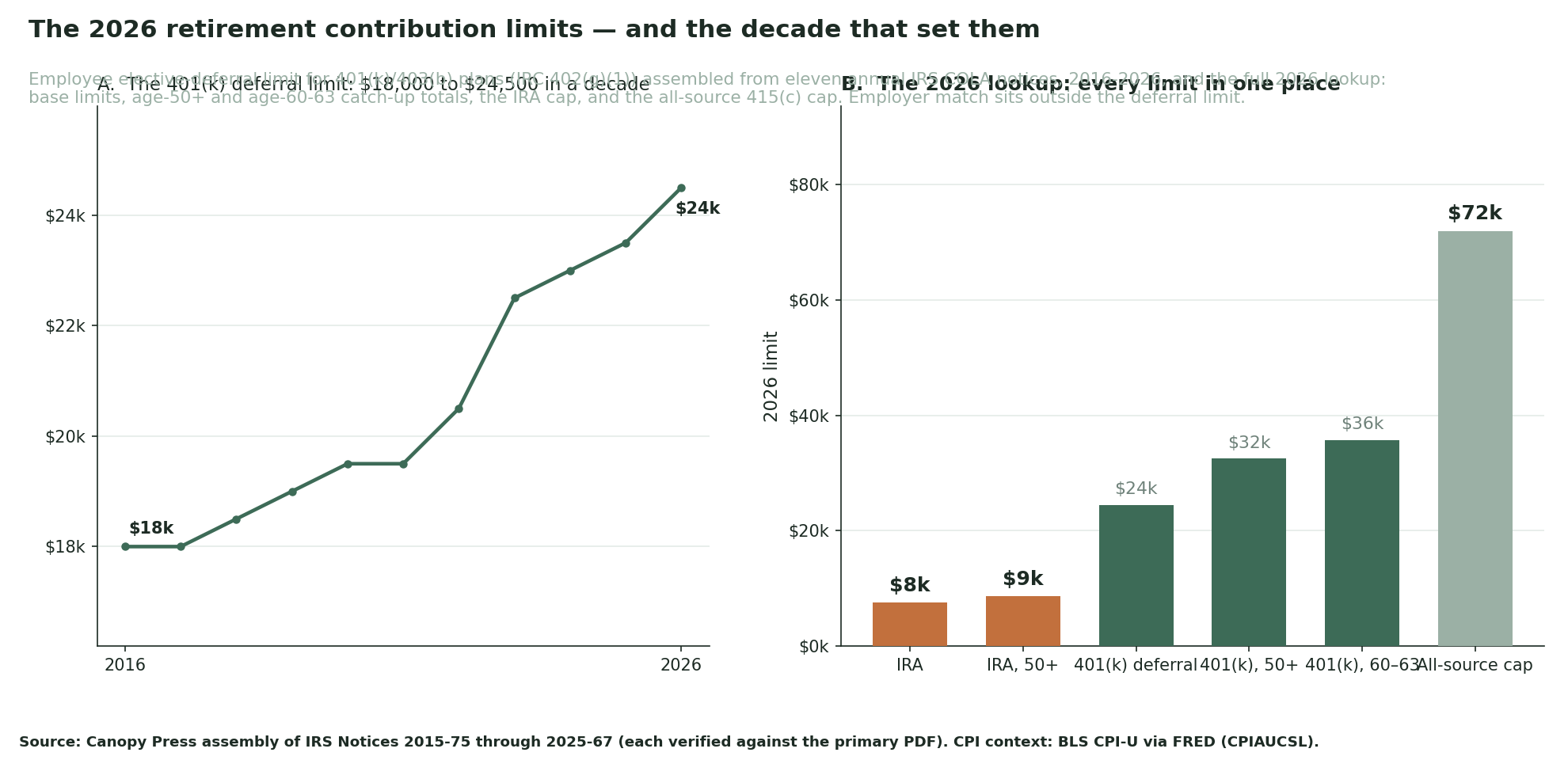

The 2026 lookup
| Limit | 2025 | 2026 |
|---|---|---|
| 401(k) deferral | $23,500 | $24,500 |
| 401(k), 50+ | $31,000 | $32,500 |
| 401(k), 60–63 | $34,750 | $35,750 |
| All-source cap | $70,000 | $72,000 |
| IRA | $7,000 | $7,500 |
| IRA, 50+ | $8,000 | $8,600 |
The elective-deferral limit (IRC 402(g)(1)) caps the employee's own salary deferrals across 401(k)/403(b) plans; governmental 457(b) plans carry an equal but separate limit. Employer matching and profit-sharing money counts toward the all-source 415(c) cap (and is separately bounded by the compensation and employer-deduction limits), not the employee deferral limit. The IRA figure is a combined traditional-plus-Roth cap. Whether a traditional-IRA contribution is deductible, and whether you're eligible to contribute to a Roth at all, is separately limited by income-based phase-outs not covered here. From 2026, catch-up contributions by employees whose prior-year Federal Insurance Contributions Act (FICA) wages exceeded $150,000 must be made as Roth (SECURE 2.0).
The assembled history, 2016–2026
| Year | IRS notice | 401(k) deferral limit | IRA limit |
|---|---|---|---|
| 2016 | Notice 2015-75 | $18,000 | $5,500 |
| 2017 | Notice 2016-62 | $18,000 | $5,500 |
| 2018 | Notice 2017-64 | $18,500 | $5,500 |
| 2019 | Notice 2018-83 | $19,000 | $6,000 |
| 2020 | Notice 2019-59 | $19,500 | $6,000 |
| 2021 | Notice 2020-79 | $19,500 | $6,000 |
| 2022 | Notice 2021-61 | $20,500 | $6,000 |
| 2023 | Notice 2022-55 | $22,500 | $6,500 |
| 2024 | Notice 2023-75 | $23,000 | $7,000 |
| 2025 | Notice 2024-80 | $23,500 | $7,000 |
| 2026 | Notice 2025-67 | $24,500 | $7,500 |
Have the limits kept up with inflation?
Not quite — at least not through 2025. From 2016 through 2026 the 401(k) deferral limit rose 36.1% ($18,000 → $24,500) and the IRA limit 36.4% ($5,500 → $7,500). Those limit figures run through 2026, though, while the inflation yardstick stops a year earlier: consumer prices rose 34.1% from 2016 through 2025, the latest complete CPI year. Measured over that same 2016–2025 window the limits actually trailed inflation — had the 2016 deferral limit simply tracked CPI it would have reached roughly $24,100 by 2025, against an actual 2025 limit of only $23,500. The 2026 limit jump narrows — and may close — that gap, but a true like-for-like verdict has to wait for the complete 2026 CPI reading; against the latest fully-measured year (2025) the limits still sit slightly behind inflation. The statute indexes in $500 steps from its own base period, so the actual limit oscillates around the smooth CPI path rather than matching it dollar-for-dollar; the comparison is directional context, not a policy gap.
Methodology
The assembly. Each year's limits come from that year's IRS cost-of-living-adjustment notice (2016: Notice 2015-75 … 2026: Notice 2025-67; the full year-by-notice mapping is in the CSV). Every value was verified against the primary notice PDF on irs.gov and pinned in Canopy Press's hand-verified limits file, which the build snapshots. No single IRS table publishes this multi-year series — the assembly is the dataset.
The CPI counterfactual. The 'if indexed to CPI' figures scale the 2016 limit by CPI-U annual averages (FRED CPIAUCSL) and round to the nearest $100, through 2025 (the latest complete CPI year). It is Canopy Press arithmetic for context — approximate by construction, because the statute rounds in $500 increments from a different base.
Confidence. High for every statutory limit (verbatim from the cited primary notices). The counterfactual row is labeled approximate wherever it appears.
Reuse permitted with attribution to Canopy Press (CC BY 4.0). Full underlying figures: CSV download. Sources: IRS Notices 2015-75, 2016-62, 2017-64, 2018-83, 2019-59, 2020-79, 2021-61, 2022-55, 2023-75, 2024-80, 2025-67 (irs.gov primary PDFs); BLS CPI-U via FRED series CPIAUCSL. This is informational, not tax advice.