
The number tax-loss sellers ask for every December: in 2026 a filer can deduct up to $3,000 of net capital losses against ordinary income — $1,500 if married filing separately. Two mechanics around that cap matter more than the cap itself: capital losses first offset capital gains without any dollar limit, and whatever the $3,000 cap strands carries forward indefinitely to future years (IRC 1212(b)).
The cap is one of the tax code's frozen numbers. Congress set $3,000 in the Tax Reform Act of 1976 (after a $2,000 phase-in for 1977, the cap has applied since 1978) and has never indexed it. Measured in 2025 dollars, the limit was worth about $14,800 when it took effect in 1978 — an erosion of about 80% in real terms, on a cap Congress has left unindexed for 48 years.
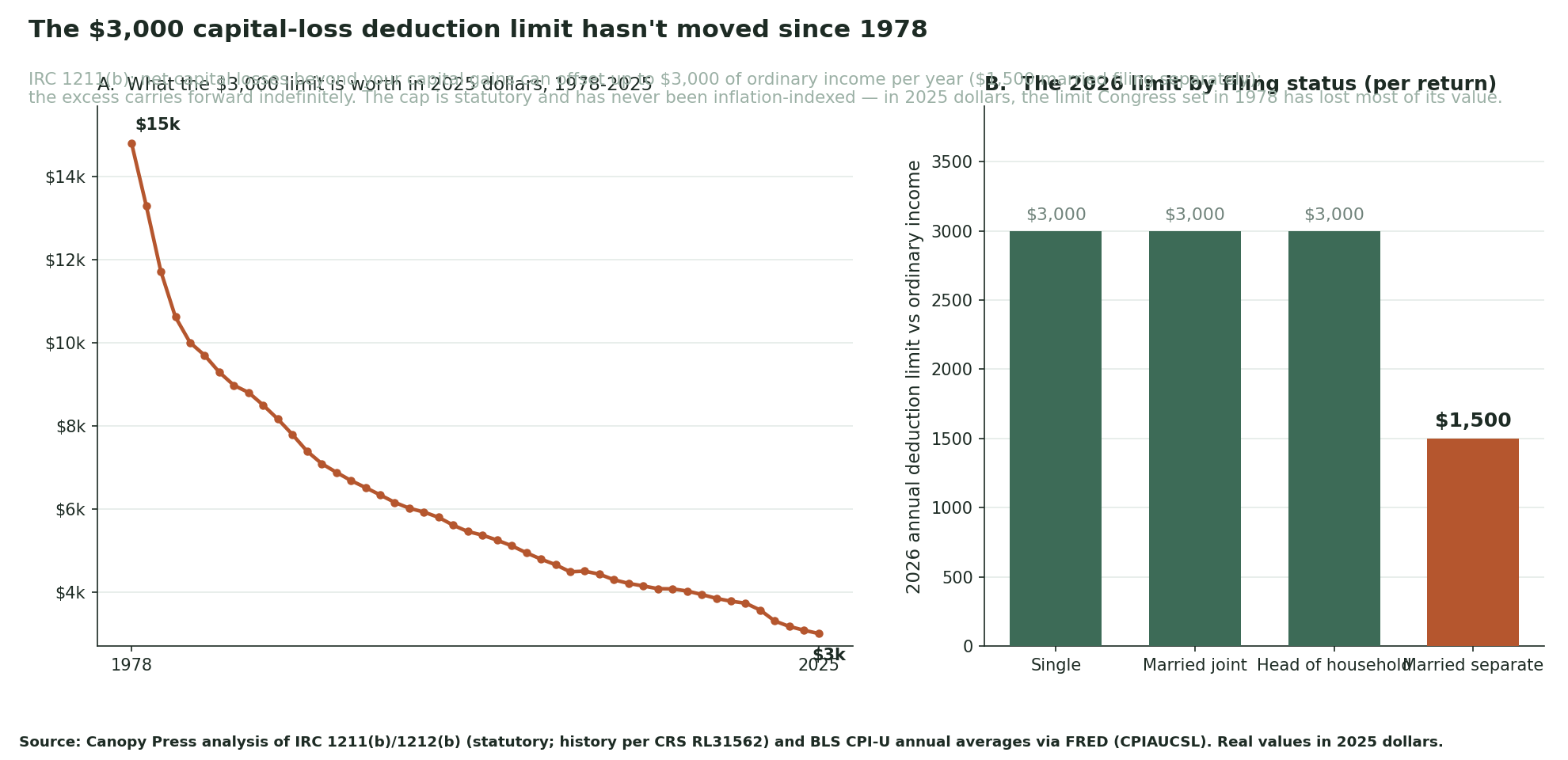

The 2026 numbers
| Filing status | 2025 limit | 2026 limit |
|---|---|---|
| Single | $3,000 | $3,000 |
| Married joint | $3,000 | $3,000 |
| Head of household | $3,000 | $3,000 |
| Married separate | $1,500 | $1,500 |
The limit is per RETURN: a married couple filing jointly gets the same $3,000 as a single filer — one of the code's quiet marriage penalties — while married-filing-separately filers get $1,500 each. Statutory values verbatim from IRC 1211(b); they do not change year to year because the section has no inflation adjustment.
How the deduction actually works
- Gains first, no limit. Capital losses offset capital gains dollar-for-dollar with no cap. Someone with $50,000 of gains and $50,000 of losses owes no capital-gains tax and never touches the $3,000 limit.
- Then up to $3,000 against ordinary income. If losses exceed gains, up to $3,000 of the net loss ($1,500 MFS) reduces wages, interest, and other ordinary income in the current year.
- The rest carries forward — indefinitely. A $20,000 net loss deducts $3,000 this year and carries $17,000 forward (IRC 1212(b)), usable against future gains without limit or against ordinary income at $3,000 per year, retaining its short-term/long-term character.
- Watch the wash-sale rule. Buying a substantially identical security within 30 days before or after the sale disallows the current loss, adding it to the replacement shares' basis (IRC 1091) — context worth knowing before selling for the deduction; not analyzed here.
- Federal rules only. Every figure here is federal. State treatment of capital-loss deductions and carryforwards varies — some states cap or disallow them differently — so confirm your state's rules separately.
A limit frozen since 1978
| Period | Limit (per return) | Set by |
|---|---|---|
| 1942–1976 | $1,000 | Revenue Act of 1942 |
| 1977 | $2,000 | Tax Reform Act of 1976 (phase-in year) |
| 1978–present | $3,000 | Tax Reform Act of 1976 — never indexed since |
Because the cap never moves, inflation does the legislating. In 2025 dollars the limit was worth about $14,800 in 1978, $5,600 in 2000, and $4,400 in 2010 — against $3,000 today. CRS reached the same conclusion with an earlier endpoint: adjusting for inflation since 1978 would put the limit at about $13,000 in 2022 dollars (RL31562). Our series extends that arithmetic through 2025 on the same official CPI-U index.
Methodology
Statutory values. The limits are reproduced verbatim from IRC 1211(b) ($3,000; $1,500 for a married individual filing separately) via Canopy Press's pinned, hand-verified limits file, and the carryforward from IRC 1212(b). The statutory history ($1,000 from the Revenue Act of 1942; $2,000 for 1977 and $3,000 for tax years beginning after 1977 per the Tax Reform Act of 1976, P.L. 94-455) follows CRS Report RL31562. These are statutes, not estimates.
The real-value series. real_value(year) = $3,000 × CPIAUCSL(2025) ÷ CPIAUCSL(year), using BLS CPI-U annual averages via FRED. 2025 is the latest complete calendar year; the identity real_value(2025) = $3,000 holds by construction. This is Canopy Press's constant-dollar arithmetic, not an official inflation adjustment — no such official figure exists, because the statute has none.
Confidence. High: the limits are statutory text, and the real-value series is deterministic arithmetic on one official index, anchored against CRS's independently published ~$13,000 (2022 dollars) estimate.
Reuse permitted with attribution to Canopy Press (CC BY 4.0). Full underlying figures: CSV download. Sources: IRC 1211(b), 1212(b) (U.S. Code); CRS Report RL31562, An Analysis of the Tax Treatment of Capital Losses (2022 update); BLS CPI-U via FRED series CPIAUCSL. This is informational, not tax advice; confirm your numbers with a tax professional.